
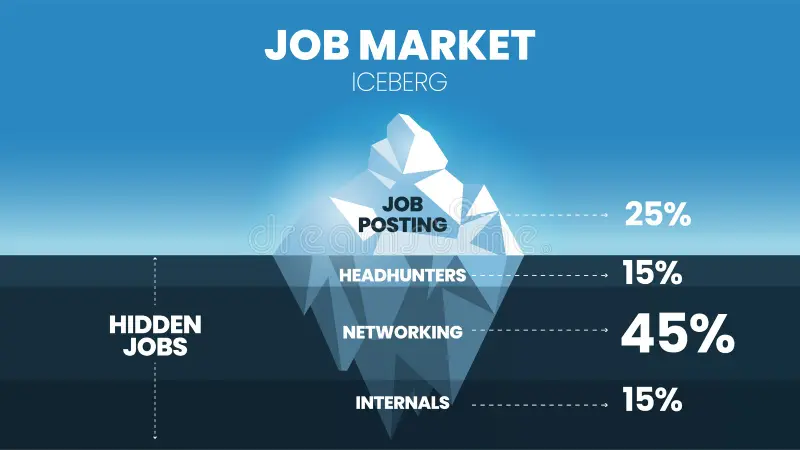
Unfortunately, nobody at school told you this. Your careers adviser talked about CVs, personal statements and interview technique. Nobody explained that 85% of jobs never get advertised on a job board, and that most professional roles get filled through personal connections before a vacancy goes public. If someone had told you that on day one, you might have spent less time perfecting your LinkedIn headline and more time actually talking to people.
For UK young people navigating a job market with approximately 720,000 open vacancies, understanding the hidden job market is not a soft skill. It is a survival tool. In this guide, we break down how to build authentic professional relationships that open doors to unadvertised roles.
READ ALSO: How to Upgrade your Job Search
The Hidden Job Market Is Not a Myth
Only 6% of all job applications come with a referral, yet those referrals account for 37% of all hires. Meanwhile, 89% of hiring managers say referrals matter when filling a vacancy. Referred candidates also get hired around 55% faster than those going through traditional career sites.
In the UK, 39% of British workers found their current job through their network. Half of British Gen Z workers secured their role through networking specifically. That second statistic is worth reading twice. Half of your generation is already doing this. The other half is applying through job boards and wondering why the process feels so slow.
What the Research Says About Long-Term Career Success
The case for networking extends well beyond landing a first role. Hans-Georg Wolff and Klaus Moser at the University of Erlangen-Nuremberg conducted a longitudinal study tracking how networking behaviours affect career outcomes over time. Their findings showed that keeping in touch with former contacts, attending industry events, and spending time with colleagues outside work all directly correlate with career success.
Salary data backs this up. Research by Berardi and Seabright found that growing your professional network by 50% produces a 3.8% higher salary. That is a compounding financial benefit, not a one-time recruitment advantage.
Why Young People Find It Hard and What Actually Works
Forty percent of professionals feel uncomfortable networking, with introversion and fear of rejection as the most common barriers. The good news is that formal networking events are not the only entry point.
Fifty percent of job seekers find opportunities through casual conversations. A thoughtful comment on someone’s LinkedIn post, a genuine question in an industry forum, or an email to someone whose work you admire: these interactions count and they compound. The Chartered Institute of Personnel and Development recommends starting by mapping your existing network before trying to expand it. Former teachers, university lecturers, part-time managers, family contacts in relevant industries: most people already have more of a starting network than they realise.

Quality Beats Quantity Every Time
Forty-eight percent of professionals struggle to maintain connections consistently. A network of 500 people you never speak to is worth far less than 50 people who would genuinely pick up the phone for you.
Sociologist Mark Granovetter’s landmark research on the “strength of weak ties” found that acquaintances and distant connections are actually the most powerful sources of new opportunities. Your close network already moves in your circles. Your weak ties connect you to entirely different worlds.
Referred hires also stay 20% longer at companies than those hired through traditional applications. That is the real long-term payoff: not just a faster route in, but a better fit and a longer runway.
Start building your network now. Not when you need something. Now.
If you want to make an active impact in our quest to educate young people and provide them with updates on everything going on, subscribe here.
- Working Hard but Going Nowhere? The Career Trap Millions of Workers May Not Recognise
- NHS and AI: What 44 New Recommendations Could Change for Patients
- Breast Cancer Awareness: Why Early Detection Matters and What You Need to Know
- Why Gillian Anderson’s West End Controversy Matters for Theatre Audiences
- UK Jobs in the AI Era: Why Workers Need to Build New Skills
