
Imagine stepping onto a West End stage after spending decades becoming one of the most recognisable faces on television and film. The lights come up, hundreds of people are watching, and there is nowhere to hide—not behind a camera angle, not behind an edit, not behind a retake. Then imagine discovering that some of the people sitting closest to you have watched the same performance again and again, to the point where their presence has begun to affect your concentration. That is the extraordinary situation surrounding Gillian Anderson’s current West End run.
Anderson, internationally known for The X-Files, The Crown and Sex Education, is currently starring as Martha opposite Billy Crudup in Edward Albee’s Who’s Afraid of Virginia Woolf? at the intimate @sohoplace theatre. The production, directed by Marianne Elliott, is being staged in the round and runs until 19 December 2026. But it is not Anderson’s performance alone that has captured attention.
A video showing the actress confronting a group of fans who repeatedly sat in the front row has triggered a wider conversation about celebrity, fandom and theatre etiquette. Anderson told the fans that their repeated presence was distracting and later explained that her comments were directed at people she has known for more than 20 years. What might initially look like a celebrity-fan disagreement is actually something much bigger.
What happens when the audience becomes part of the performance, and when celebrity makes the boundary between performer and spectator increasingly difficult to maintain?
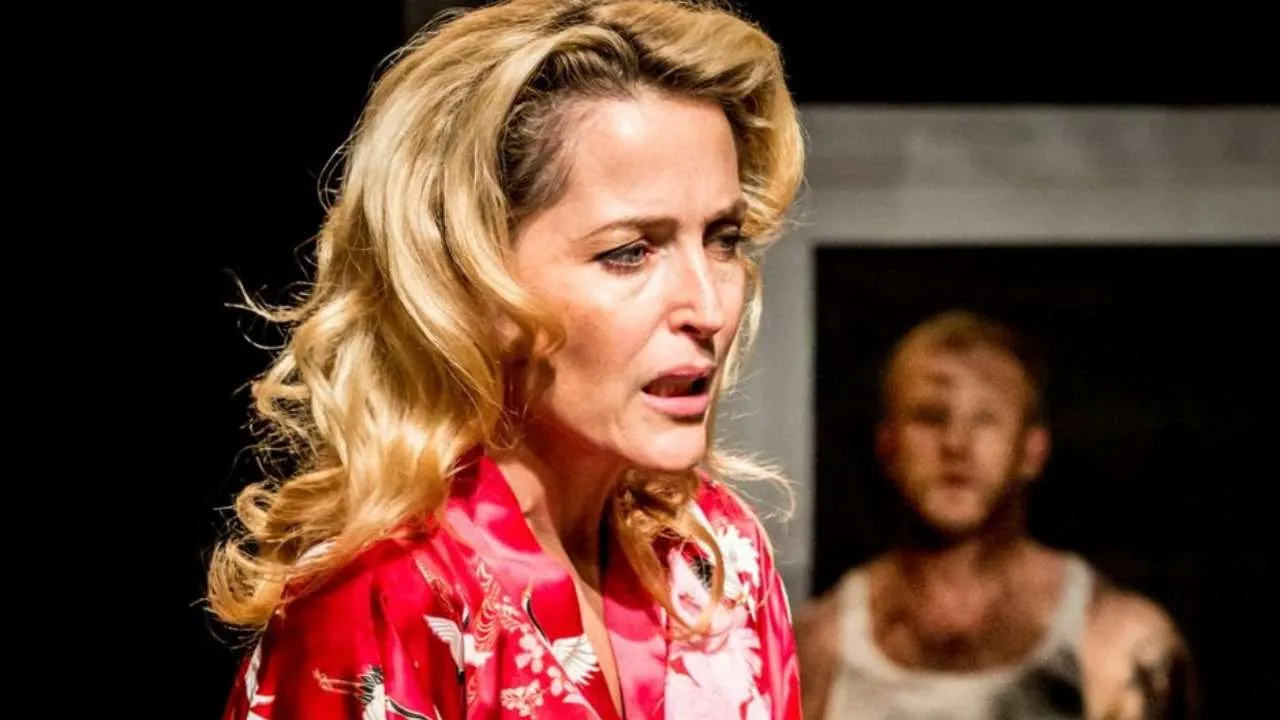
The West End Is Not a Film Set
There is a fundamental difference between watching an actor on screen and watching that same actor perform live. Film allows mistakes to disappear. Scenes can be repeated. Cameras can be repositioned. Performances can be edited. Background noise can be removed. An actor can deliver a line badly and nobody watching the finished product will ever know. Theatre offers none of that protection. Once the curtain rises, the performance is happening in real time. Actors have to remember lines, maintain concentration, respond to their fellow performers and remain emotionally connected to the world of the playall while knowing that hundreds of people are watching their every movement.
Anderson’s situation brings that pressure into sharp focus.
Who’s Afraid of Virginia Woolf? is hardly a lightweight production. The play revolves around the volatile marriage of Martha and George, with emotional manipulation, resentment, humour and psychological warfare gradually escalating across the evening. The Guardian described Anderson’s performance as fierce and intense, with the production running for more than three hours. For an actor performing such emotionally demanding material, concentration is not a luxury. It is part of the job.
When Celebrity Becomes Part of the Ticket
Celebrity has always been one of the West End’s attractions. A famous actor can generate publicity before the first rehearsal. Their name can sell tickets, attract media attention and introduce new audiences to theatre. For someone who knows Gillian Anderson primarily as Dana Scully from The X-Files or as Margaret Thatcher in The Crown, seeing her perform live in London offers something television cannot provide. The audience is not simply buying a theatre ticket. They are buying the opportunity to see someone they already know enter a completely different world. That can be wonderful for theatre, but it can also create complications. Some audience members may arrive primarily to see Gillian Anderson, rather than Martha.

That distinction matters.
Theatre requires the audience to surrender itself to the fictional world. Celebrity can pull attention in the opposite direction, reminding spectators that the person in front of them is also a famous public figure they have watched elsewhere.
- The actor wants the audience to see Martha.
- The fan may still be seeing Gillian.
- The Front Row Has Become a Different Kind of Space
In a conventional theatre, the front row already carries a certain intensity. The actors can see the faces clearly. The audience is close enough to become part of the actors’ visual environment. But @sohoplace’s production is staged in the round, placing the performers in the middle of the audience. That makes the relationship unusually intimate. Now consider what happens when the same people repeatedly occupy the seats closest to the stage. The experience can become less like performing before an anonymous audience and more like performing directly to familiar individuals. That can be emotionally powerful. It can also be distracting.
Anderson’s complaint therefore raises a fascinating question: does a devoted fan’s enthusiasm remain harmless when the performer begins experiencing that enthusiasm as part of the working environment? The fan has paid for a ticket. The actor has agreed to perform before an audience. Both are entitled to be there. But both also have responsibilities. The audience must allow the performer to perform. The performer must respect the audience’s right to enjoy the experience. The difficulty begins when those expectations collide.
Fandom Has Changed
Celebrity culture has transformed dramatically in the social-media era. Fans no longer simply watch their favourite actors on television.
- They follow them online.
- They comment on their posts.
- They attend conventions.
- They travel to see productions.
- They collect photographs and merchandise.
Some fans develop relationships with celebrities that feel remarkably personal even when the relationship is fundamentally one-sided. That phenomenon can be intensified when an actor returns to live theatre. A fan may see an opportunity to watch their favourite performer repeatedly, perhaps from the best possible seat. From the fan’s perspective, that may represent admiration. From the actor’s perspective, repeated recognition from the same audience members can become impossible to ignore. The boundary becomes blurred. The audience thinks, “I know you.” The actor may be thinking, “You know my work, but you do not know what I need in order to perform.” That distinction is increasingly important in modern celebrity culture.
Theatre Audiences Are Under Pressure Too
It would be easy to make Anderson’s story entirely about the responsibility of fans. But theatre audiences are themselves navigating a changing cultural environment. Theatre etiquette has become a recurring concern across the performing arts. Actors including Cate Blanchett, Rosamund Pike, Cynthia Erivo and Lesley Manville have spoken about disruptive behaviour such as phone use, texting, recording and other forms of inappropriate audience conduct. The smartphone has fundamentally altered the relationship between performer and spectator. For generations, theatre asked audiences to put their phones away and surrender themselves to the performance. Now, spectators are accustomed to documenting everything. A memorable moment happens and the instinct is to record it. A celebrity appears and the instinct is to photograph them. Something unusual happens and within minutes, it can be on TikTok. And that creates a strange contradiction.
The technology that brings celebrities closer to audiences can simultaneously make it harder for performers to maintain the concentration live theatre requires.
The Audience Is Not Just a Consumer
There is another important point. Theatre is different from streaming because the audience is physically present. That presence matters. A great audience can elevate a performance. Laughter can energise actors. Silence can deepen a dramatic moment. Collective emotional reactions can make a performance feel extraordinary. The audience is therefore not simply consuming theatre. It is participating in it. But participation requires boundaries. An audience member who laughs at the right moment contributes to the atmosphere. An audience member who repeatedly distracts an actor may undermine it.The difference is subtle, but crucial.
Celebrity Can Help the West End
Despite the controversy, celebrity casting is not necessarily a problem. In fact, it can be enormously beneficial. When a globally recognised actor appears on the West End stage, people who might not normally attend theatre may become interested. Anderson’s enormous television profile can introduce Who’s Afraid of Virginia Woolf? to audiences who might otherwise never have considered seeing an Edward Albee play. That is valuable. Theatre needs audiences. The West End needs commercial success. Productions need publicity. And famous actors can provide all three. There is a reason celebrity casting continues to be attractive to producers. The celebrity brings attention. The stage provides artistic credibility. And the audience gets the opportunity to see a familiar face doing something they cannot experience through a screen.
But Celebrity Also Raises Expectations
The other side of the equation is pressure. When an unknown actor performs, audiences may judge the performance primarily on what happens on stage. When a major celebrity performs, the audience may arrive with years of expectations. They already know the actor’s face. That can create an enormous burden. Anderson is not simply playing Martha. For some members of the audience, she is simultaneously Scully, Margaret Thatcher, Jean Milburn and every other character they have seen her play. The actor must somehow make the audience forget all of that. The greatest challenge of celebrity theatre may therefore be making the celebrity disappear.
Live Theatre Demands Something Different
This is why theatre continues to matter in the age of streaming. A streaming service can give audiences a polished performance. Theatre gives them risk. Something could go wrong. An actor could forget a line. The audience could react unexpectedly. The energy could change from one night to another. No two performances are completely identical. That uncertainty is not a weakness. It is the magic. And it explains why theatre etiquette matters so much. When people buy a ticket, they are not simply buying entertainment. They are entering into an agreement with the performers and everyone else in the room. For a few hours, everyone agrees to protect the illusion.
The West End Is Selling Experience, Not Just Performance
The modern theatre audience increasingly wants more than a good play. They want an experience, watch famous actors and to feel close to the action. They want something worth discussing afterwards. Social media has intensified this desire. A theatre production can now become a cultural event before audiences even enter the building. That can be enormously powerful for London’s West End. But it also creates a danger. If audiences become more interested in the celebrity experience than the theatrical experience, the play itself can become secondary. The actor becomes the attraction. The character becomes the photograph. The performance becomes the content. And the theatre risks becoming another extension of celebrity culture.
The Real Question: Who Owns the Performance?
Anderson’s experience raises a surprisingly deep question. Who owns a live performance?
- The actor?
- The producer?
- The playwright?
- The audience?
Technically, the performance belongs to everyone involved in creating it. But emotionally, it belongs to nobody. It exists only for that moment. That is why theatre is so fragile. Once the final curtain falls, that exact performance is gone. The audience cannot replay it. The actor cannot reproduce it perfectly. And perhaps that is why everyone inside the theatre has a responsibility to protect it.
Celebrity and Theatre Need Each Other
The relationship between celebrity and theatre is therefore unlikely to disappear. If anything, it will become more important. Television and streaming platforms have created global celebrities who can bring enormous attention to the stage. Theatre, in turn, offers those celebrities something increasingly rare: the chance to perform without a safety net. It reminds audiences that behind the famous face is an actor who still has to learn lines, rehearse, concentrate, take risks and deliver the performance night after night. That vulnerability can be incredibly powerful. But it requires respect from both sides. Celebrities need to understand that audiences are passionate because they care. Audiences need to understand that performers are human beings, not characters who exist solely for their entertainment.
The Curtain Falls, But the Conversation Continues
Gillian Anderson’s West End controversy may eventually disappear from the headlines. The production will close. The fans will move on. Another celebrity will take another stage. But the underlying question will remain. As celebrity becomes increasingly accessible, are audiences forgetting that access is not ownership? A famous actor may be visible everywhere online, but the moment they step onto a stage, something changes. They are no longer simply a celebrity. They are a performer doing a difficult job in real time. And the audience is no longer merely a collection of fans. It becomes part of the performance. Perhaps that is the lesson buried beneath the controversy. The West End does not need audiences to love its actors less. It needs them to understand what that love requires.
Admiration should not become intrusion. Enthusiasm should not become distraction. And celebrity should never be allowed to erase the humanity of the performer.

Conclusion
The next time you enter a West End theatre, remember that the person standing beneath those lights is not a screen image that can be paused, edited or restarted. Give performers your attention, respect the space, put the phone away and allow the story to take over. Celebrity may get you through the theatre doors, but respect is what keeps live theatre alive. Because ultimately, the magic of the West End depends on something remarkably simple: An actor willing to give everything and an audience willing to truly watch.
