


Ever had your mind go blank in a job interview at the dreaded ‘customer service’ question? Or maybe you’ve dismissed the term entirely, thinking it’s just for retail jobs and has nothing to do with your real career goals. If you’ve ever felt nervous about dealing with clients for a new side hustle or simply lacked the confidence to handle a tough conversation with a stakeholder, you’re not alone. We get it. But what if we told you that this one skill could be the key to unlocking major opportunities?
The truth is, understanding what is great customer service is about so much more than just being polite. It’s a powerful set of communication, empathy, and problem-solving skills that can transform how you work with everyone-from clients and colleagues to managers and collaborators. In this guide, we’re breaking it all down. We’ll move beyond the textbook definitions to empower you with the essential skills that will help you build an incredible reputation, gain unshakable confidence, and turn every professional interaction into a win for your career.
Key Takeaways
- Move beyond the outdated idea that “the customer is always right” and learn how to create positive, empowering outcomes for everyone involved.
- Understanding what is great customer service is a career superpower that helps you build stronger relationships with colleagues, managers, and clients alike.
- Master the core skills that make people feel heard and valued, transforming any interaction into an opportunity for connection and success.
- Discover actionable strategies to showcase your exceptional service skills in your next job interview and on the job to accelerate your career growth.
Beyond ‘The Customer is Always Right’: Redefining Service for Your Generation
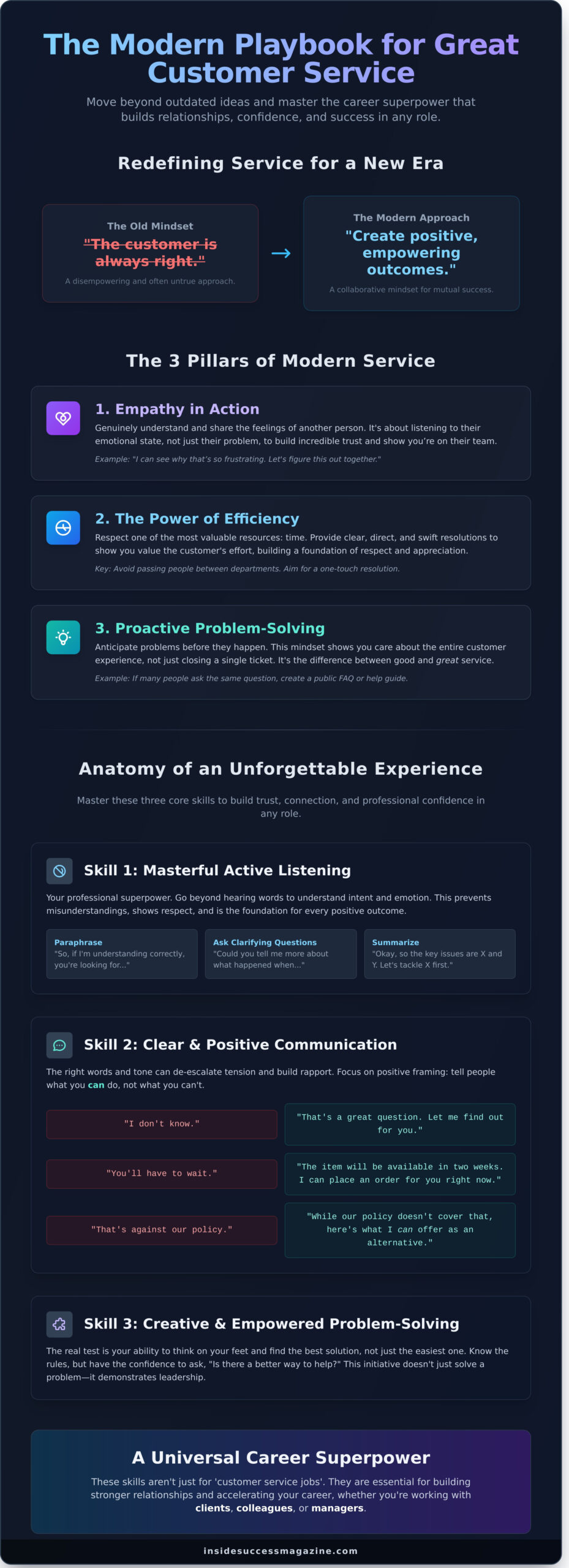
You’ve probably heard the old saying, “The customer is always right.” For generations, that was the golden rule. But let’s be honest: it can feel disempowering and, frankly, it’s often not true. Today, the answer to what is great customer service has evolved. It’s no longer about being submissive; it’s about building confidence, finding solutions, and creating positive outcomes for everyone involved.
This skill isn’t just for retail or call centers-it’s a powerful mindset that will set you apart in any career you pursue. While the foundational definition of what customer service is remains centered on providing support, the modern approach is built on three core pillars that transform a simple transaction into a meaningful connection.
Pillar 1: Empathy in Action
Empathy is the skill of genuinely understanding and sharing the feelings of another person. In practice, this means listening to a customer’s emotional state, not just their problem. Acknowledging their frustration with a simple, “I can see why that’s so frustrating,” before you even offer a solution shows you’re on their team. This simple act builds incredible trust and transforms a one-time customer into a long-term supporter.
Pillar 2: The Power of Efficiency
Great service respects one of the most valuable resources anyone has: their time. Efficiency is about providing clear, direct, and swift resolutions. Think about the difference between getting a straight answer in a two-minute chat versus being passed between five different departments over an hour. Prioritizing a quick and effective solution shows you value the customer’s time and effort, building a foundation of respect and appreciation.
Pillar 3: Proactive Problem-Solving
Good service solves the problem in front of you. Great service anticipates problems before they even happen. This is the proactive mindset that truly shines. For example, if you notice multiple people asking the same question, you don’t just keep answering it-you create a clear help guide or FAQ page. This shows you care about the entire customer experience, not just closing one support ticket.
The Anatomy of an Unforgettable Customer Experience
Ever had a simple interaction-buying a coffee, asking for directions-that left you feeling genuinely good? That’s the magic of exceptional service. It isn’t about grand gestures; it’s about small, intentional actions that make someone feel heard, valued, and understood. So, what is great customer service at its core? It’s a collection of powerful, transferable skills that build trust and connection. Mastering them won’t just impress a customer; it will build your professional confidence and transform you into the person everyone relies on to get things right.
Let’s break down the three core skills you can start developing today to empower yourself in any role.
Skill 1: Masterful Active Listening
This is your professional superpower. Active listening goes beyond just hearing words; it’s about understanding the intent and emotion behind them. By truly tuning in, you prevent misunderstandings and show genuine respect. It’s the foundation for every positive outcome. Practice these techniques to build your listening skills:
- Paraphrase: “So, if I’m understanding correctly, you’re looking for…”
- Ask clarifying questions: “Could you tell me a bit more about what happened when you tried to log in?”
- Summarise: “Okay, so the key issues are the delivery date and the payment error. Let’s tackle the delivery first.”
Skill 2: Clear and Positive Communication
The right words, delivered with the right tone, can de-escalate a tense situation and build immediate rapport. The goal is to be a source of clarity and optimism, not confusion. Focus on positive framing-tell people what you can do, not what you can’t. Here’s how to reframe common negative phrases:
- Instead of: “I don’t know.”
Try: “That’s a great question. Let me find out for you.” - Instead of: “You’ll have to wait.”
Try: “The item will be available in two weeks. I can place an order for you right now.” - Instead of: “That’s against our policy.”
Try: “While our policy doesn’t cover that, here’s what I can offer as an alternative.”
Skill 3: Creative and Empowered Problem-Solving
Sometimes, the script isn’t enough. The real test of what is great customer service is your ability to think on your feet and find the best solution, not just the easiest one. This means knowing the rules but also having the confidence to ask, “Is there a better way to help?” Taking the initiative to find a creative fix doesn’t just solve a problem; it demonstrates leadership, builds resilience, and shows that you are an invaluable asset to any team.
Why ‘Customer Service’ is a Core Skill for EVERY Career (Yes, Even Yours)
Let’s be real: when you hear “customer service,” you probably picture a headset or a retail counter. But that’s a narrow view that could be holding your career back. The truth is, mastering the principles of great service is a power move, no matter your job title. The secret is to redefine your “customer.” A customer is anyone you serve, provide value to, or depend on to get your work done. This includes your clients, your colleagues, and your manager.
When you adopt this mindset, you don’t just do your job-you build relationships, solve problems, and create opportunities. This shift transforms you from just another employee into an essential partner in success.
For the Aspiring Entrepreneur & Freelancer
In the gig economy, you aren’t just selling a skill; you’re selling an experience. Your service is your brand. Excellent service transforms happy clients into a volunteer marketing team, generating referrals that build your business. It’s how you justify premium pricing and create a loyal client base. Think of a freelance designer who proactively sends a client progress updates, even when not required. That simple act of great service is what secures a long-term retainer contract.
For the Coder, Designer, and Tech Professional
You might not be on the phone with external clients, but you have customers everywhere. Your “customers” are:
- Product managers requesting a new feature.
- End-users whose feedback you need to understand.
- Teammates who depend on your code.
Applying a service mindset means practicing empathy to build better, more intuitive products. Clear, proactive communication prevents costly revisions and saves entire projects from derailing.
For Climbing the Corporate Ladder
Want a promotion? Start treating your manager and cross-functional partners like your most important clients. Being the person who delivers high-quality work on time, communicates roadblocks clearly, and proactively offers help makes you indispensable. Leaders at every level understand what is great customer service because they know that empowering their team (their internal customers) is the key to achieving incredible results. This skill set isn’t just helpful; it’s a core trait of effective leadership.
How to Demonstrate Great Customer Service (In an Interview and On the Job)
Understanding the theory is a great start, but proving you can deliver exceptional service is what truly builds your career. It’s not just about what you know; it’s about what you do. The key is to move beyond just listing skills on your CV and start telling compelling stories that show your abilities in action.
Acing the Interview Question
When an interviewer asks you to describe a time you provided excellent service, they’re testing your understanding of what is great customer service. Use the STAR method to structure your answer and make it memorable:
- Situation: Briefly describe the context. What was the challenge?
- Task: What was your specific responsibility or goal?
- Action: What steps did you take? Focus on your problem-solving and empathy.
- Result: What was the positive outcome? Quantify it if you can (e.g., “the customer left a 5-star review”).
Your story should highlight your ability to listen, connect, and solve problems effectively.
Handling Difficult Customers and Colleagues
Conflict is inevitable, but how you handle it defines you. Whether it’s an upset customer or a frustrated teammate, stay calm and follow this simple 3-step process: Listen, Acknowledge, Act. Imagine a colleague is upset about a missed deadline. Instead of getting defensive, listen to their frustration, acknowledge their point of view (“I understand you’re under pressure”), and then act by proposing a solution (“Let’s work together to fix this right now”). This shifts the focus from blame to collaboration.
Building Your Reputation from Day One
True service excellence is built through consistent, small actions. From your very first day, focus on becoming the person everyone knows they can rely on. Be responsive to emails, always follow up on your promises, and look for opportunities to be proactive instead of reactive. Don’t be afraid to ask for feedback on your communication and work. These habits build trust and show that you are committed not just to your tasks, but to the success of the entire team.
Ready to master these skills and build the confidence to succeed in any role? Join our upcoming webinar!
Unlock Your Career Superpower: Great Customer Service
Ultimately, understanding what is great customer service is about recognizing its true potential. It’s not a script to follow, but a mindset built on empathy, resilience, and genuine connection. We’ve seen how this skill transcends traditional service roles to become a core asset in any career, empowering you to build stronger relationships and solve complex problems. Mastering this is how you transform from a good candidate into an indispensable team member, someone who consistently adds value and builds trust.
Feeling inspired to turn this knowledge into a tangible advantage? It’s time to take action. Want to truly master this skill? Register for our exclusive webinar on Great Customer Service! You’ll get actionable tips to boost your career now, learn from career experts featured in InsideSuccessMagazine, and join a community of ambitious young professionals ready to grow with you. This is your opportunity to build the confidence and skills that will set you apart. Go get it.
Frequently Asked Questions
What are the 3 most important qualities of customer service?
While many skills matter, three pillars truly stand out: empathy, patience, and clear communication. Empathy allows you to genuinely understand a customer’s frustration, while patience is crucial for navigating difficult conversations. Clear communication ensures you can explain solutions effectively and build trust. Mastering these qualities is the foundation for providing supportive service, empowering you to handle any situation with confidence and turn a negative experience into a positive one.
Can you give an example of going ‘above and beyond’ in customer service?
Imagine a customer orders a gift that arrives damaged. Good service is replacing it. Going ‘above and beyond’ is express shipping the replacement for free, gift-wrapping it, and including a handwritten apology note with a small discount for their next purchase. This action doesn’t just solve the problem; it shows you value their business and care about their experience. It transforms a moment of frustration into one of genuine appreciation and builds lasting loyalty.
How do you handle a customer who is clearly wrong?
The goal isn’t to prove them wrong, but to make them feel heard and find a solution. Start by actively listening and validating their feelings with phrases like, “I can see why that’s so frustrating.” Then, gently guide them toward the correct information without placing blame. Focus on what you *can* do for them. This approach de-escalates tension, builds resilience, and shows that your priority is helping them, not winning an argument.
What’s the difference between customer service and customer experience?
Think of it like this: customer service is a specific interaction, like calling support or speaking to a cashier. Customer experience (CX), on the other hand, is the entire journey and the overall feeling a person has with a brand, from seeing an ad to using the product. Understanding what is great customer service is about perfecting those individual touchpoints, which in turn helps to build a positive and memorable overall customer experience.
How can I develop customer service skills if I don’t have a customer-facing job?
Great news: you’re likely already building these skills! Customer service is about communication, problem-solving, and empathy-all transferable skills. Practice active listening with friends, offer to help a colleague on a difficult project, or volunteer for a cause you care about. These opportunities allow you to practice navigating different personalities and finding solutions collaboratively. Every interaction is a chance to build the confidence and skills you need to excel in any future role.
What is the hardest part of being in a customer service role?
One of the biggest challenges is maintaining emotional resilience. You are often the first point of contact for people who are frustrated or upset, and it can be tough not to take it personally. The key is to develop a strong sense of empathy without absorbing their negativity. Learning to de-escalate situations and remembering the frustration isn’t about you is a powerful skill that builds incredible personal strength and confidence for any career path.

I am a creative professional specializing in Web Development, WordPress Development, and Product (UI/UX) Design. I design and build responsive, high-performance websites and intuitive digital products that merge sleek aesthetics with seamless user experiences. I blend code and creativity to help brands grow, engage users, and stand out in the digital space. Beyond building, I also mentor individuals looking to learn and I actively collaborate with fellow developers and designers to bring bold ideas to life.

Leave a Reply
You must be logged in to post a comment.